
Miniature Horse History
 |
 |
 |
Miniature horses were used in England & Northern Europe as far back as the 1700's to pull ore carts in the coal mines. They were also bred by European royalty as pets for the royal children. In the 19th century, some miniatures were brought to the United States to be used in the mines in Ohio and West Virginia. Many early breeders imported horses from Europe, especially England and Holland, which helped to create the miniature breed, as it is known today. Some miniatures trace back to the Falabella Ranches in Buenos Aries, Argentina, South America, which was founded in the mid 1840's. This ranch was dedicated to breeding down miniatures from larger horses.
|
Cochise Warrior (28 1/4" tall) (50% Falabella) owned by: Mini-Go-Round Farm |
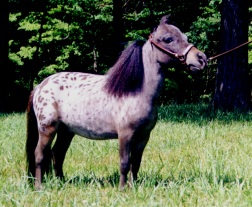 |
Falabella Stallion (Lost Spoke's El Hombre Falabella) Grandsire: 100% Falabella Stallion (Grosshill's Comofin) |
Some of the 'unknown' sires and dams listed
on many of the foundation miniatures may have come from the Shetland breed,
as many of the early Shetlands were smaller than their modern day cousins.
In fact, in the 1st ASPC stud book, the average Shetland's height was only
a little over 40", and a few of the early registered Shetlands only measured
between 28' and 34" tall. Roughly 1/4 of them measured under 38"
tall.
Later on in the 70's, as other people imported
stock or tried to register unregistered stock, but found they couldn't,
new registries began to start up. Around 1977, the International
Miniature Horse Registry opened on the west coast and in 1978, the American
Miniature Horse Association (AMHA) opened in Texas. Several others
followed, but eventually most of them folded or were absorbed by the AMHA.
The AMHA only recognizes miniature horses up to 34" tall, however, in 1986,
the AMHR voted in a "B" registry, which allowed a 34" to 38" division of
miniatures. This "B" division came about by popular demand of the
members. Their reasons for wanting the "B" division were varied,
but included such things as, the gene pool was too small and new blood
was needed, some breeders were getting dwarfs, some mares were having trouble
foaling due to their small size, some breeders were getting excellent animals
over 34", and some wanted to start miniature horse racing with the larger
minis and mechanical riders.
Both the AMHR and the AMHA have sanctioned
shows, including National Shows, where today's miniatures can be shown
in halter and showmanship classes, or compete in performance classes, such
as driving, jumping, and obstacle. Miniature horses are easy to handle
and fun to show. Today's miniature horses also make wonderful family
pets, because of their gentle nature and small size. They are small
enough for a young child to safely handle and care for. Children
can learn how to care for a miniature horse long before they are big enough
to handle standard size horses. Larger "B" size miniature can be
ridden by a small child, and when they outgrow the miniature, it can be
trained to easily pull a cart or small wagon. Even though they can't
carry a large amount of weight on their back, they are very strong and
can pull even adults in a cart. They are the perfect size for parades,
fair exhibitions, playdays, etc. They can be shared at schools, nursing
homes, and parties, as well as in your own backyard. The elderly
enjoy them, as miniatures make a good alternative to the full sized horse,
which they may no longer feel physically able to handle. There are
even classes in which the physically disabled can participate in with miniatures.
They can also be trained to use as guide animals for the blind & their
lifespan is much longer than that of guide dogs, as miniatures can live
for 30 yrs or longer, making them very valuable for this use.
 |
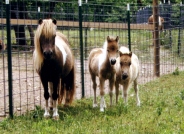
are lots of Fun!! |
 |
Miniature horses are truly a special breed.
So, "CATCH THE MINI FEVER" and give us a call today for a one of a kind
friend for life--the AMERICAN MINIATURE HORSE. But beware, owning
Minis is very contagious, you can't have just one.
|
Miniature HorseFarm 400 Lippert Drive Rogers, Arkansas 72756 U.S.A. Phone ~ 1-479-640-7381 |
 |
Lippert e-mail: cindy@mini-go-round.com |
Contact us at: E-mail: cindy@mini-go-round.com Phone: 1-479-640-7381
 |
 |
 |
 |
 |